A business gift is aimed at a professional relationship and is subject to the tax rules of the Dutch Tax Authorities (Belastingdienst). A personal gift is emotional in nature and belongs in the private sphere. This distinction sounds simple, but in practice, the difference lies in three questions: who is the recipient, what is the purpose, and how do you record it?
- Recipient: client, supplier, or business partner? Then it's a business gift. Friend, partner, or family member? Then it's a personal gift.
- Purpose: is it about relationship management or appreciation within a professional context? Business. Is it an emotional gesture without a business consideration? Personal.
- Administration: for business gifts, you keep the invoice, note the recipient and the occasion, and keep an eye on the VAT threshold of €227 excluding VAT per relationship per year.
Pro-tip: Are you unsure whether a gift is business or personal? Ask yourself: would you still give this if there was no business relationship? If the answer is no, it is business. Record it as such in your administration.
Key insights
The difference between a personal and business gift lies in three factors: the recipient, the occasion, and the documentation, with the VAT threshold of €227 per relationship per year forming the fiscal dividing line.
| Point | Details |
|---|---|
| Business vs. personal | Business = professional relationship and occasion; personal = emotional and private in nature. |
| VAT threshold €227 | If you stay below €227 excluding VAT per relationship per year, the VAT on the gift is fully deductible. |
| Threshold counts per company | Multiple gifts to contacts from the same company add up; the limit applies per relationship, not per person. |
| Documentation is decisive | Note name, company, occasion, and date on the invoice; that makes the difference in a VAT audit. |
| Cocktailsbynina as a business gift | A Cocktailsbynina cocktail box can be used for business purposes provided the occasion and invoice demonstrate the business context. |
Table of contents
- What exactly is a business gift?
- When is a gift personal?
- When do you choose which type of gift?
- How to choose the right gift step by step?
- What are the tax and VAT rules for business gifts?
- Which gift ideas are suitable for business and which for personal?
- When is a cocktail box personal and when business?
- Do's and don'ts for personal and business gifts
- A cocktail box as a business gift: this is how it works at Cocktailsbynina
- Sources
What exactly is a business gift?
A business gift is a present you give in a professional context, to existing clients, suppliers, or business partners. The purpose is relationship management, representation, or strengthening a business bond. Not increasing your turnover through a direct action.
This latter distinction is fiscally crucial. As soon as a gift is part of a commercial campaign or promotional action, its classification shifts to advertising costs or promotional costs, which are treated differently for tax purposes. A business gift must be incidental and given without direct consideration.
Typical purposes of a business gift:
- Relationship management: thanking an existing client or partner for the collaboration
- Representation: presenting your company in a positive way
- Networking: strengthening a first impression with a new business relationship
- Visibility: increasing brand awareness without it being an advertising campaign
Concrete examples of business gifts:
- A premium cocktail box as an end-of-year gift for a loyal client
- A gift voucher for a supplier for an anniversary
- A bottle of wine or a culinary package for a contract extension
- Branded but high-quality glassware for a business relation
The fiscal relevance lies in the VAT deductibility and the representation rules. More on this in the section on VAT and fiscal aspects further on.
When is a gift personal?
A personal gift has an emotional character and is aimed at the person themselves, not at a business relationship or consideration. You give it to a friend, partner, family member, or colleague with whom you have a personal bond that is separate from work.

The identifying feature is the intention. A personal gift is almost always surprising, intimate, or highly personalized. It suits the person, not a function or company.
Characteristics of a personal gift:
- Strong personalization: tailored to hobbies, taste, or a shared memory
- No business context: there is no professional relationship or consideration involved
- Emotional value is central, not monetary value
- Often spontaneous or for a personal occasion (birthday, birth, wedding)
Examples:
- A piece of jewelry with personal engraving
- A handwritten letter with a matching gift
- A cocktail box as a birthday gift for a good friend, without any business occasion
Pro-tip: A gift that you could also use for business purposes becomes personal as soon as the occasion is purely private. But beware: if you want to claim it as a business expense, the business context must be demonstrable. When in doubt: pay privately.
When do you choose which type of gift?
The choice depends on two factors: who the recipient is and what the occasion is. Below is an overview by recipient and by occasion.
Recipient as starting point:
- Client or supplier: always business, even if you have a personal connection
- Business partner or investor: business, unless your friendship is clearly separate from the collaboration
- Colleague: depends on the occasion; a farewell or anniversary can be business, a birthday is personal
- Friend or family member who is also a client: personal, unless the gift explicitly concerns the business relationship
- Partner or family member: always personal
| Occasion | Recommended type | Motivation |
|---|---|---|
| End-of-year gift to client | Business | Relationship management, representation |
| Contract renewal | Business | Appreciation for business collaboration |
| Colleague's birthday | Personal | Private occasion, no business context |
| Supplier's anniversary | Business | Professional milestone |
| Wedding or birth | Personal | Emotional occasion, private sphere |
| Condolence | Personal | Always private, never claim as business |
| Thank you after project | Business | Business context, documentable |
How to choose the right gift step by step?
A good gift choice does not start with the product, but with the goal. Go through these steps before ordering anything.
-
Define the goal. Is it about appreciation for an existing relationship or acquisition? Appreciation falls under representation. Acquisition shifts towards promotional costs. This determines the fiscal classification.
-
Determine the recipient and check company rules. Some companies have an internal policy regarding accepting gifts. If you send a gift to an employee of a large company, ask if there is a threshold. Above a certain value, the recipient may have to refuse or report the gift.
-
Keep an eye on the budget and the VAT threshold. The Tax Authorities apply a threshold of €227 excluding VAT per relationship per year. If you stay below it, the VAT is fully deductible. If you go above it, additional rules apply.
-
Choose quality over cheap promotional items. A generic pen with a logo does little for the relationship and is harder to justify as representation costs. A premium cocktail box or a quality glassware set reinforces the business intention and makes a better impression.
-
Ensure presentation and personalization without bribery risk. A personal card or a reference to the collaboration makes the gift more relevant. But avoid gifts that are so valuable that they could be seen as influence, especially in sectors with strict integrity rules.
Pro-tip: For every business gift purchase, immediately note: recipient's name, company, occasion, date, and value. Do this on the invoice or in an internal logbook. In a VAT audit, this is your proof that it is a business gift, not a private expense.
What are the tax and VAT rules for business gifts?
The tax treatment of business gifts in the Netherlands revolves around the BUA rules (Decree on Exclusion of VAT Deduction) and the €227 threshold.
The €227 threshold:
If you give gifts to one relationship per year with a total value of up to €227 excluding VAT, the VAT on those gifts is fully deductible.
Important detail: since January 1, 2024, a personal contribution from the recipient no longer counts in the calculation of the threshold amount. Your total expenses per relationship count fully, even if the recipient has paid a part themselves.
Please note: the €227 limit applies per relationship (read: per company), not per contact person. If you send three gifts to three different employees of the same company, the total value adds up for that one company.
Representation costs and food/drinks:
Gifts in the category of food and drinks, such as a cocktail box or a culinary package, also fall under representation costs. For representation costs, there is a deduction limitation in income tax: the first €5,700 per year is not deductible, or you opt for a deduction limitation of 20% of the total amount.
Distinction with employee gifts:
Business gifts fall under the BUA and representation rules. Employee gifts fall under the Work-Related Costs Scheme (WKR). Incorrect allocation can lead to corrections during a tax audit. In doubt? Consult a tax advisor or check the explanation on the KvK website.
Checklist for your administration:
- Name and company of the recipient
- Date and occasion (event, thank you, anniversary)
- Value excluding VAT
- Cumulative total per relationship per year
- Invoice saved and linked to the relationship file
Which gift ideas are suitable for business and which for personal?
Business gift ideas:
- Premium cocktail box: high-quality, presentable, and easy to invoice as a business gift. A cocktail box for two works as a gesture; a box for six suits a larger team or a concluding event.
- Culinary package or wine box: timeless and broadly appreciated, provided the value stays within the VAT threshold.
- Experience event: a cooking workshop or tasting for a small team strengthens the relationship and is easy to document as representation.
- Quality glassware: a cocktail glass set with subtle brand reference is functional and lasting.
- Gift voucher: flexible and value-retaining, such as a gift voucher that the recipient can use themselves.
Personal gift ideas:
- A piece of jewelry or accessory with personal engraving
- A photo album or framed memory
- A cocktail box as a birthday gift for a good friend, purely as an experience gift
- An experience voucher for something the recipient has long wanted to do
The difference is not always in the product itself. A cocktail box can be business if you send it to a client after a completed project, and personal if you give it to your best friend on their birthday. Context and administration determine the qualification, not the product.
When is a cocktail box personal and when business?
The same product, two totally different fiscal and relational contexts. That's how it works in practice.
Scenario A: Business
A marketing agency concludes a project with a client. They send a premium cocktail box as a thank you, along with a personal card. The invoice states: client name, company name, date, occasion ("project X completion") and value excluding VAT. The total gift value for this company remains below €227 that year. The VAT is fully deductible.
Scenario B: Personal
The same cocktail box, but now a friend sends it to another friend for their birthday. There is no business relationship, no invoice for the company, and no fiscal classification. It is a private expense.
What determines the difference? Three elements:
- The relationship: business or private?
- The occasion: professional milestone or personal occasion?
- The documentation: is it in the business administration with the correct context?
Tax experts advise always emphasizing the business purpose in the administration, even if a product like a cocktail box appears private at first glance. The business intention must be demonstrable, not just plausible.
Pro-tip: Always note the occasion in one sentence on the invoice or in your accounting software: "Business gift for the completion of project X, client Y, date Z." That one sentence can make the difference between deductible and non-deductible during an audit.
Cocktailsbynina offers ready-made cocktail boxes that can be used for both business and personal purposes, depending on the context. The professional packaging and the option to receive an invoice addressed to your company make them suitable as corporate gifts.
Do's and don'ts for personal and business gifts
Do's:
- Tailor the gift to the recipient and the occasion
- Always keep the invoice and note the business context
- Choose quality: a quality corporate gift is easier to justify during an audit than a cheap promotional item
- Keep track of how much you spend per client per year so you don't inadvertently exceed the €227 threshold
- Check if the recipient has an internal gift acceptance policy
Don'ts:
- Do not give gifts that are so valuable they could be seen as bribery, especially in the public sector or in companies with strict integrity rules
- Never claim a personal gift as a business expense without demonstrable business grounds
- Remember that gifts to multiple contacts within one company add up for that company's VAT threshold
Quick checklist before sending:
- Is the recipient a business or personal contact?
- What is the occasion, and is it business or private?
- Will the cumulative value for this contact this year remain below €227 excluding VAT?
- Have you kept the invoice with the name, company, date, and occasion?
- Does the value of the gift fit the business context, without risk of bribery?
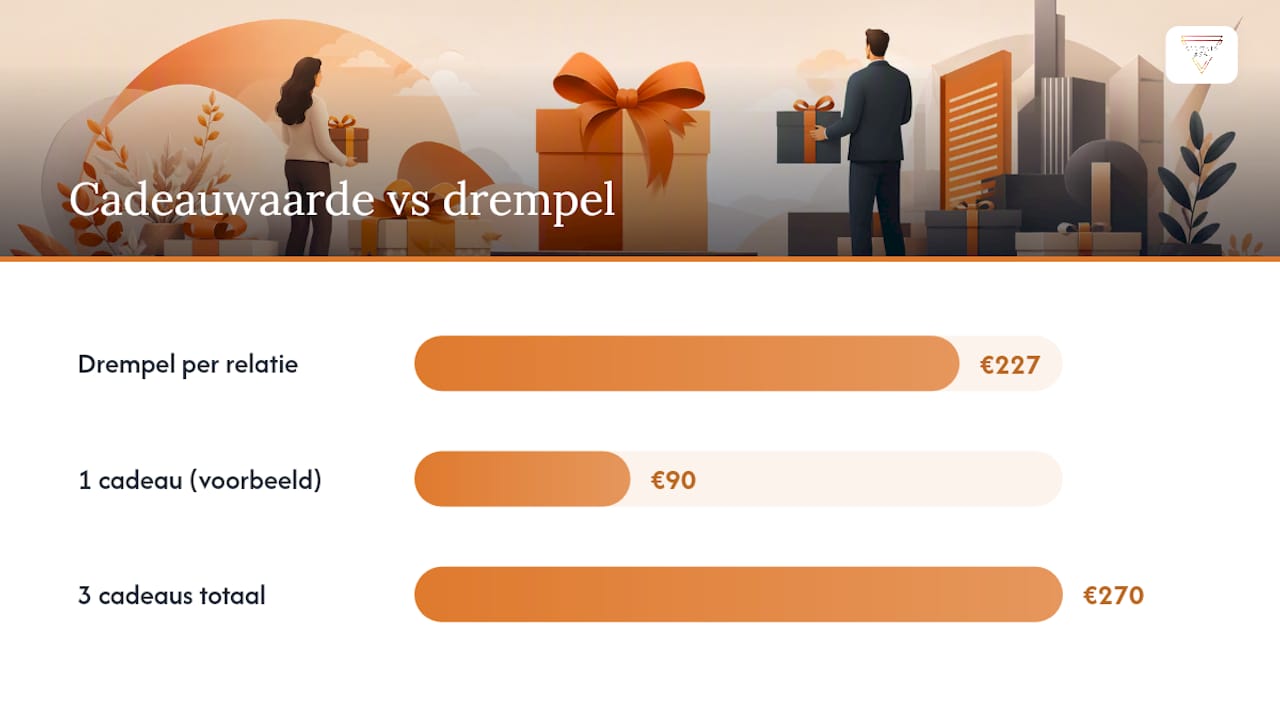
Warning: If you send multiple gifts to different employees of the same company, the total value adds up for that one client. Three gifts of €90 to three colleagues at the same company means €270 in total, which exceeds the threshold.
A note from the author
What I notice in practice: many entrepreneurs treat gifts as an afterthought, while the fiscal and relational consequences can sometimes be quite favorable or unfavorable. The difference between a well-documented corporate gift and a private expense that you accidentally booked as business often comes down to one line on an invoice. That's little effort for something that can save a lot of hassle during an audit.
A cocktail box as a corporate gift: how it works at Cocktailsbynina
Cocktailsbynina delivers premium cocktail boxes that are professionally packaged, ready to serve, and suitable for both personal and business occasions. For companies looking for a corporate gift that stands out without being over-the-top, this is a practical starting point.

The cocktail box for four works well as a token of appreciation for a small team or as an end-of-year gift for a loyal customer. The box for six suits larger clients or closing events. Both come in elegant packaging that supports the business intent. You will receive an invoice addressed to your company, which immediately takes care of the administration.
View the full assortment at Cocktailsbynina and choose the package that fits the relationship and budget.
Sources
For those who want to further investigate the tax details or check the current rules:
- Claiming VAT on gifts, corporate gifts and staff provisions | Tax Authorities
- Corporate gifts and taxes: these are the rules | Chamber of Commerce
- Are corporate gifts tax deductible? VAT rules for business gifts - MKB Servicedesk
- All rules regarding the tax deductibility of corporate gifts - TvdW
Use these sources to: check current threshold amounts, compare examples to your situation, and consult a tax advisor if in doubt.
This article contains general information and does not replace the advice of a qualified financial advisor. Consult a qualified financial professional about your own situation before acting on the basis of this content.