Cocktail catering typically costs between approximately € 250 per hour for smaller commitments and € 6 to € 20 per person for an all-inclusive price. The exact price depends on the chosen pricing model, the number of guests, the level of personalization, and the permits required for your location. The larger your group and the more standard the menu, the lower the price per person usually is.
In short:
- For smaller events, costs are usually calculated hourly, with rates between € 250 and € 750 depending on the scale and location.
- For large groups of one hundred guests or more, a flat fee per person is often more cost-effective, ranging from € 6 to € 20, depending on the menu.
- Providers charge extra costs for premium drinks, glassware, logos, or additional hours not included in the base price.
- Permits and hygiene requirements can affect costs and generally require timely application and attention to regulations.
- A minimum purchase requirement may be most cost-effective for small-scale events, while large events are better off with an all-inclusive package for efficiency.
Table of contents
- Pricing models and market indications for cocktail catering
- What is included in the standard price and what costs extra?
- Checklist: what questions to ask when requesting a quote?
- Which permits and hygiene requirements play a role in the Netherlands?
- Minimum purchase, economies of scale, and when all-inclusive pays off
- Our take on ready-to-serve vs. custom catering
- Cocktails by Nina as a fast and predictable option
- Frequently asked questions
- Sources
Pricing models and market indications for cocktail catering
Cocktail catering providers usually work with two pricing models: hourly or per person via a flat fee. Which model fits best depends on the size and nature of your event.

For smaller, informal occasions, hourly billing is often used. You hire a bartender or a small team for a fixed duration, usually between three and six hours. Indicative ranges lie between € 250 and € 750 per hour, depending on the size of the bar, the number of bartenders, and the location. A house party with a single bartender is at the lower end of that range, while a corporate event with a full mobile bar and multiple staff members heads toward the upper end.
For larger or longer events, clients more often choose a flat fee per person. This model provides more certainty about the total cost beforehand, which is convenient when setting an event budget. Typical bandwidths lie between € 6 and € 20 per person, where the lowest segment represents simple mocktails or a limited cocktail menu, and the highest segment represents premium spirits and extensive personalization.
A few calculation examples, purely for illustration and without any guarantee that your quote will turn out the same:
- A birthday party with 30 guests and four hours of bar service at € 400 per hour comes to a total of about € 1,600, or approximately € 53 per guest.
- A company reception with 150 guests at a flat fee of € 10 per person costs € 1,500 in total, which is much less per guest than in the first example.
A flat fee often becomes more cost-effective once you exceed one hundred guests, because the fixed costs for materials and personnel are then spread over more people.
What is included in the standard price and what costs extra?
Not every quote covers the same components, making prices difficult to compare at first glance. Most providers include a fixed base package and charge separate surcharges for extras.
- Bartender or bartenders, tailored to the number of guests.
- Basic ingredients for a limited cocktail menu.
- A simple bar with standard glassware and ice.
- Setup and breakdown of the bar around the event.
What are often charged separately include premium spirits or branded drinks, rented or personalized glassware, a logo or theme on the menu, extra service hours beyond the agreed-upon time, and travel costs outside a certain radius. A provider that offers everything included is therefore often higher in the starting price than a provider that only charges for the basics.
Pro-tip: always request quotes for the exact same package (number of bartenders, hours, menu) from different providers; otherwise, you are comparing apples and oranges.
Checklist: what questions to ask when requesting a quote?
A good quote leaves no room for surprises afterward. Ask these questions before you make a choice:
- What pricing model is used: hourly, per person, or a flat fee for the entire event?
- Is there a minimum purchase requirement, and are VAT and travel costs already included in the stated price?
- How many bartenders are deployed per number of guests, and how many cocktails are served on average per hour?
- Are glassware, ice, and cooling included, or are these charged separately?
- What are the cancellation terms, and is the provider insured against damage or incidents?
- Can the provider demonstrate that they work according to HACCP guidelines and are familiar with the points of attention of the NVWA?
Anyone who checks these points in advance prevents an attractive quote from turning out to be more expensive than expected afterward.
Which permits and hygiene requirements play a role in the Netherlands?
Permits and food safety are not secondary matters: they influence both the planning and the final costs. Municipalities differ greatly in what they require and how long an application takes.
Costs for catering permits vary greatly per municipality, with example amounts between € 500 and € 3,500 for certain permits, and an application can take several weeks, sometimes up to a maximum of a few weeks.
Keep this in mind well in advance, especially if your event depends on a temporary exemption or alcohol permit.
Besides permits, strict rules apply to food safety. The NVWA sets requirements for hygiene and temperature control when selling food and drinks at events, where perishable products must be kept below a fixed temperature. Therefore, always ask a provider for verifiable HACCP working methods. Usually, the caterer handles food safety themselves, but the municipal permit is generally your responsibility as the client, so start that application on time.

Minimum purchase, economies of scale, and when all-inclusive pays off
Many providers apply a minimum purchase: a lower limit in guests, hours, or revenue below which they will not accept a booking. This threshold exists because fixed costs for personnel and material do not pay off for a very small group.
- The larger the group, the lower the price per person usually turns out to be because fixed costs are spread over more guests.
- For small, informal gatherings, hiring a bartender individually is often more cost-effective than a full package.
- For larger events, an all-inclusive package often saves time and money, because logistics and purchasing are more efficient.
If in doubt, you can use the rule of thumb that a small-scale, informal party is better off with individual components, while an event with many guests and a tight schedule benefits more from an all-inclusive package.
Our take on ready-to-serve vs. custom catering
Ready-to-serve cocktails are strong when time, consistency, and logistics carry more weight than a fully staffed bar: think of a company party where everyone must be served quickly and simultaneously. A staffed bar with bartenders remains the better choice when interaction, theater, and an extensive custom menu are central. Experience shows that many clients combine these two forms: a permanent bar for the basics, supplemented with ready-to-serve options for peak moments.
— Ruud
Cocktails by Nina as a fast and predictable option
When you are organizing an event and do not want to wait for a full quotation round, we offer with Cocktails by Nina a direct route to bar-quality without having to mix yourself or plan a team. We offer ready-to-serve cocktails, mocktails, and cocktail boxes that are immediately ready for service, which can save time and coordination, especially with tight schedules or larger groups.
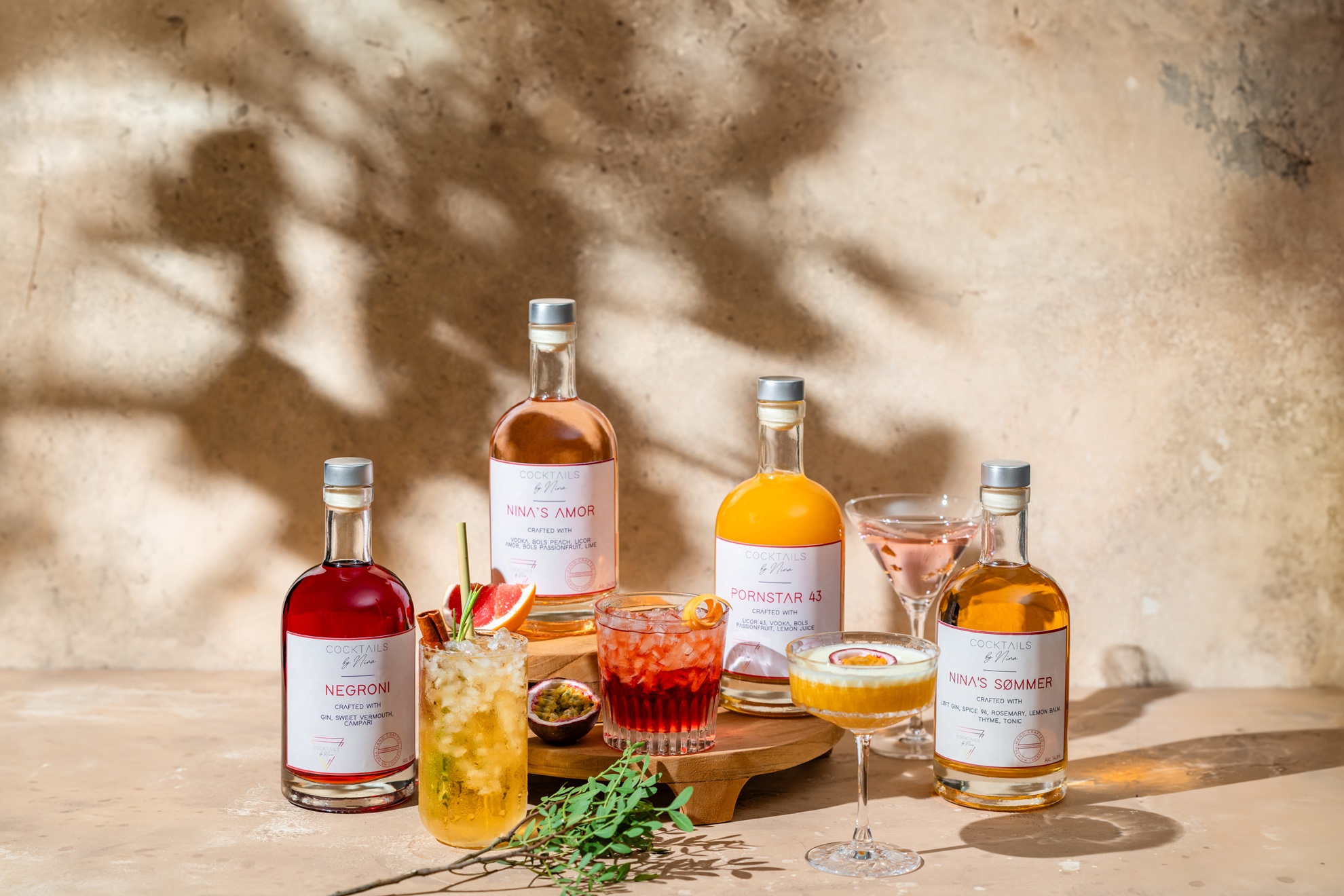
- Our cocktails and mocktails are prepared with premium ingredients and are ready to serve immediately.
- Cocktail boxes and a shot package provide variety without extra personnel.
- Via our events page, you can request a custom quote for your event.
| Need | Possible solutions |
|---|---|
| Quick service without a bartender | Ready-to-serve cocktails and mocktails |
| Variety for larger groups | Cocktail boxes and shot packages |
| Complete event advice | Quote via an events page |
Clients who prefer to book a staffed bar for their event will find a suitable alternative with traditional mobile bar providers, but those looking for speed and consistent quality without personnel logistics can request a quote directly from us via the events page.
Frequently asked questions
What are the prices for a cocktail workshop?
A cocktail workshop is usually priced separately from regular cocktail catering, with its own rate per participant that depends on the number of cocktails and the duration of the workshop. Request a specific quote from the provider, as workshop prices are independent of the ranges for catering without a workshop component.
What are the prices of mocktails?
Mocktails generally lie at the lower end of the price range for cocktail catering, as they contain no alcohol and often fewer expensive ingredients. With a flat fee per person, mocktails usually fall into the lowest segment of the range between € 6 and € 20 per person.
What are the costs of a cocktail?
The cost price of an individual cocktail depends on the ingredients, the spirits, and whether it is part of a larger catering package or ordered separately. Within a flat fee per person, you generally count on a few euros per served cocktail, depending on the chosen menu.
What does a cocktail bar cost?
A mobile cocktail bar with a bartender is usually priced hourly, with indicative ranges between € 250 and € 750 per hour, depending on scale and location. For longer or larger events, a flat fee per person is often more cost-effective than an hourly rate.
How do I best compare quotes for cocktail catering?
Always request quotes for the exact same package in terms of hours, number of bartenders, and menu, so that you can compare prices fairly. Pay attention to whether VAT, travel costs, and permits are already included in the stated amount.
Sources
- Starting a catering business: which permits do you need? | KVK
- Selling food and drinks at markets and events | NVWA