You invite friends over, want to create a fun cocktail moment, and open a recipe. Then you read: "dry shake, strain, and garnish with a twist." Those terms can be confusing. Yet, they're not as complicated as they sound, and once you understand them, your approach to home bartending will completely change. Whether you want to make an Aperol Spritz for ten people or a non-alcoholic mocktail for a children's party, the right cocktail terms give you control over flavor, texture, and presentation. This guide clearly explains everything, from shaking to garnishing, with practical tips for both cocktails and mocktails.
Table of Contents
- What are the most important cocktail terms?
- Shaking vs. stirring: technique and impact
- Practical terms for the home bar
- Party and presentation: why terms make a difference
- Why true cocktail knowledge goes beyond jargon
- Cocktail enjoyment easy and fast at home
- Frequently asked questions about cocktail terms
Key Insights
| Point | Details |
|---|---|
| Jargon is essential | Knowing terms like shaking and stirring leads to better cocktails and more party fun. |
| Technique influences taste | Shaking and stirring create different textures, flavors, and looks – choose consciously. |
| Applicable at home | With simple materials, you can use all techniques at home. |
| Mocktails included | The same terms and techniques apply to mocktails – discover variety! |
| Dare to experiment | Your own creativity and curiosity yield the most surprising results. |
What are the most important cocktail terms?
After a first glance at a cocktail recipe, many people think it's a dictionary for bartenders. But the truth is different. Each term describes a concrete action with a direct effect on what you have in your glass. Once you understand that, making cocktails is no longer a mystery.
Core terms explained
Let's start with the terms you'll encounter most often. Shaking and stirring are the two most common techniques, with shaking referring to vigorous shaking in a shaker for mixing, chilling, and aeration of cocktails with citrus, syrup, or egg white, and stirring for gentle mixing of clear, spirit-forward cocktails like the Martini.
Here's an overview of the most commonly used terms:
| Term | What it means | When to use it |
|---|---|---|
| Shaking | Vigorously shaking in a shaker | Citrus, syrup, egg white |
| Stirring | Gently mixing with a spoon | Clear cocktails, Martini |
| Muddling | Crushing fruit or herbs | Mojito, Caipirinha |
| Straining | Filtering out ice and ingredients | After shaking or stirring |
| Garnish | Decoration on or in the glass | Always, for presentation |
| Dry shake | Shaking without ice | Cocktails with egg white |
| Double strain | Double filtering through a fine mesh sieve | For a smooth texture |
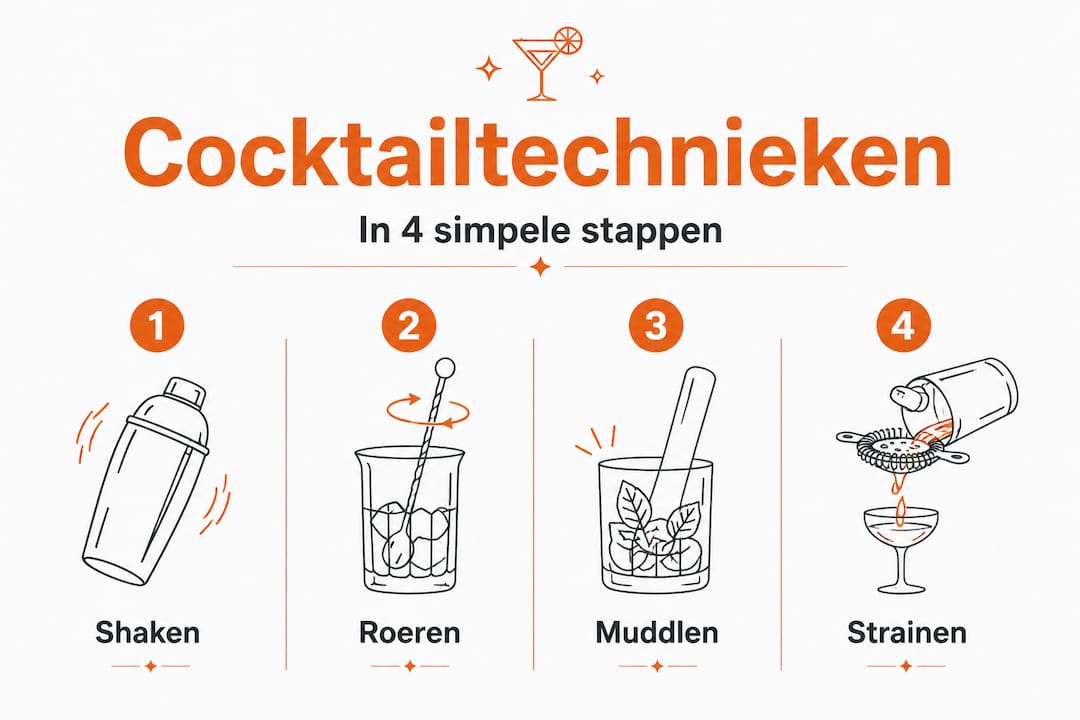
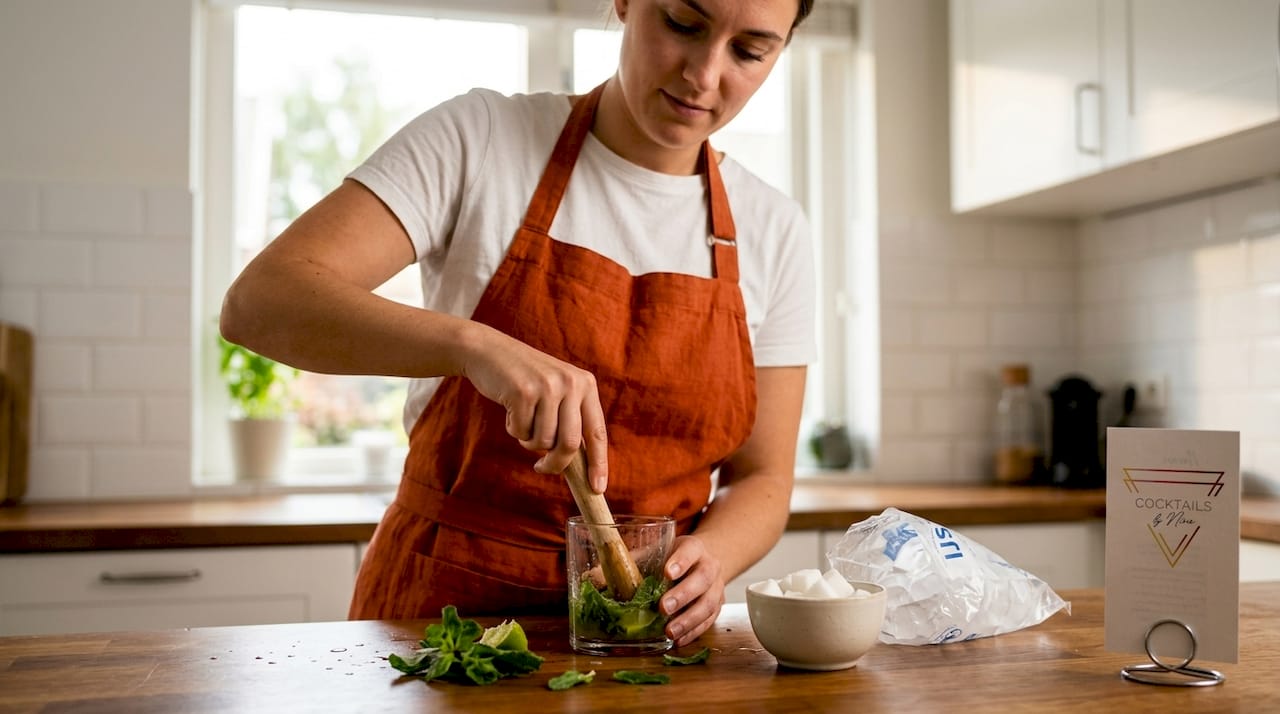
Muddling is the crushing of ingredients such as fresh mint, lime wedges, or strawberries. You use a muddler for this, but a wooden spoon also works fine. The goal is to release essential oils and juices, which directly enhances the flavor.
Straining is filtering the cocktail from ice and solid pieces. Some recipes call for double straining, where you use a fine mesh sieve in addition to the regular strainer. This results in an almost perfect, smooth liquid without bits.
Garnish is the decoration. This can be a lime slice, a sprig of rosemary, or even an edible flower. But garnish is more than just pretty: a lemon twist (a twisted piece of lemon peel) also imparts flavor to your drink through the essential oils released when twisting.
Pro-tip: The right glass truly makes a difference. A Martini belongs in a 26cl Martini glass because its wide, open shape guides the aromas upwards. A highball keeps sparkling drinks at temperature better. The choice of glassware influences your experience more than you think.
For those who want to get serious at home, a good set of tools is indispensable. The fusion kit offers a great foundation for the home bartender, while a good jigger ensures you always measure the correct quantities. Professional bartenders use a jigger for every drink, even if they've been behind the bar for years, because consistency is key to a good cocktail.
You can also draw inspiration from a wide drink collection for ideas about flavors and styles. The more you see, the better you understand which technique suits which recipe.
Shaking vs. stirring: technique and impact
Now that you know the terms, it's important to understand how they work in practice. The difference between shaking and stirring goes beyond just the action itself. It determines the texture, clarity, and even the temperature of your final result.
Why the difference really matters
Shaking versus stirring affects dilution (shaking dilutes more, on average after 10 to 15 seconds), aeration, and clarity. A shaken cocktail has small air bubbles and is slightly cloudy, which works fine for a Daiquiri or Margarita. A stirred Martini remains crystal clear and has a silky smooth texture.
Here's a comparison table:
| Aspect | Shaking | Stirring |
|---|---|---|
| Clarity | Cloudy to slightly cloudy | Clear and transparent |
| Texture | Aerated, lightly foamy | Smooth and silky |
| Dilution | Higher, due to ice and movement | Lower, more control |
| Temperature | Quickly cold, strong cooling | Slowly cold, subtle |
| Ideal for | Citrus, egg white, syrups | Strong spirits, Martini |
The edge case many people don't know about is the dry shake. For cocktails with egg white, such as a Whiskey Sour or Pisco Sour, you first shake without ice. This emulsifies the egg white and creates a stable, creamy foam on top of your drink. Then you add ice and shake again for chilling. Without that initial dry shake, you'll never get that professional layer of foam.
Step by step: from shaker to strainer
- Fill your shaker with enough ice (at least three-quarters full) for optimal cooling
- Add your ingredients in order: first the cheapest liquid, then the more expensive spirits
- Close the shaker tightly and shake vigorously for 10 to 15 seconds
- Hold the shaker with both hands, as it will get very cold
- Open the shaker and strain the cocktail through the built-in strainer
- For a double strain, also use a fine mesh sieve over the glass
- Garnish your cocktail immediately and serve immediately
For stirring, it's different. Use a mixing glass or a wide glass filled with ice. Stir for 20 to 30 seconds in one direction with a bar spoon. Slowly, calmly, and deliberately. This keeps the cocktail cold without too much dilution.
"A stirred cocktail is treated like a conversation: slow, attentive, and with respect for the ingredients."
A convenient solution for those who want to enjoy without fuss are the ready-to-drink cocktail mixes. You only need to shake or stir, without having to buy all the ingredients separately yourself. For those who want to explore the non-alcoholic side, there are excellent non-alcoholic cocktails available that deserve exactly the same techniques.
The Caribbean flavor technique beautifully illustrates how technique and flavor profile go hand in hand. Caribbean drinks are often vigorously shaken to activate fresh citrus flavors, something the local culture has considered standard for centuries.
For a neat finishing touch when pouring, pouring corks are a clever addition. They give you more control over the amount of liquid per pour, making pouring much more professional.
Practical terms for the home bar
The techniques may sound complex, but with some clever tools, you can easily apply them at home. You really don't need professional bar equipment to put cocktail terms into practice.
Shaking without a shaker
Don't have a shaker? A tightly sealed mason jar or a thermos with a lid also works. The result will be slightly less cold due to the thicker wall, but for a party at home, it's more than sufficient. Just make sure the lid is closed tightly before you start.
You can stir with a long dessert spoon or a cocktail spoon. Don't even have that? A chopstick also works in a pinch. The point is to move calmly and evenly without crushing the ice.
Straining without a strainer can be done with a coffee filter or a fine kitchen sieve. Hold the sieve over the glass as you pour. The result is a little slower, but you effectively filter out all unwanted bits.
What terms will you encounter in simple recipes?
Here are the most common terms in recipes for home use:
- Build in glass: make the cocktail directly in the serving glass, without a shaker or mixing glass
- Top up: add a sparkling ingredient like tonic, prosecco, or soda
- Free pour: pouring without a jigger, by feel (only do this if you have some experience)
- On the rocks: served over large ice cubes
- Up: served without ice in a cocktail glass or Martini glass
- Layering: carefully pouring ingredients on top of each other for visual layers
Shaking and stirring are also the basic actions for mocktails. A non-alcoholic Mojito with freshly muddled mint and lime needs a good muddling technique just as much as the classic version with rum. The flavor directly depends on it.
Mocktail tips: same technique, different ingredients
Mocktails follow exactly the same logic as cocktails. You shake, stir, muddle, and garnish in the same way. The only thing that changes are the basic ingredients. Instead of gin, you use kombucha or a herbal tea extract. Instead of rum, you use a ginger beer or coconut water.
Pro-tip: Always use a jigger for the correct amount. A jigger has two sides, usually 25ml and 50ml, and ensures you make every cocktail identically. This is crucial if you're serving multiple guests. No one wants a cocktail that's twice as sweet as the person's next to them.
If you want help organizing your home cocktail service, then the home cocktail service is an option where you are completely unburdened. And for those who want to mix themselves, a DIY cocktail kit offers everything you need in one order.
Don't forget the small details. Reusable straws are not only sustainable, but they also give your drinks a more stylish appearance. Guests notice that extra attention.
Party and presentation: why terms make a difference
Finally, you'll see how these terms not only improve your drink but also give your party a professional touch. Knowledge of cocktail terminology is actually a form of hospitality, as it shows that you've paid attention to your guests' experience.
Step-by-step cocktail presentation
- Choose the right glassware for each cocktail, as presentation begins with the shape
- Chill the glass by letting ice water sit in it for a moment, then pouring it out
- Prepare your garnish in advance, so you have everything ready at the time of serving
- Use a cocktail napkin or coaster to keep the bar tidy
- Always serve with a brief explanation of the drink; even one sentence creates connection
- Ensure a variety of cocktails and mocktails so everyone has something
Why knowledge of terms creates an authentic atmosphere
When you explain to a guest that a cocktail is stirred rather than shaken for a silky smooth texture, you create an experience. People feel that thought has gone into their drink. That's the difference between a party and an event.
Statistic to remember: Shaking takes an average of 10 to 15 seconds for optimal cooling and dilution. Less than that provides insufficient cooling; longer than that over-dilutes your cocktail and you lose balance in flavor. So those 10 to 15 seconds are not a guess, but science.
Another presentation tip: use large ice cubes instead of small ones. Large cubes melt slower, diluting your cocktail less. For a party of 20 people, this detail is incredibly valuable.
For those who want to surprise guests with a completely non-alcoholic menu, mocktails for parties are an excellent choice. They are professionally composed and look just as impressive as their alcoholic counterparts.
The cocktail glass set provides that visual unity on the table that instantly elevates your party. Mixed glassware also works, but a nice set brings calm and style to the presentation.
Why true cocktail knowledge goes beyond jargon
After all the theory and practical insights, it's time for a fresh look at the "why" behind these terms. Because here's something most cocktail guides don't tell you: the terms are a starting point, not an end point.
We see it every day. People who precisely memorize all the terms, yet their cocktail still doesn't taste good. And people who have never heard of a dry shake, but intuitively make their egg-white Sour almost perfectly. The difference lies in the willingness to taste, adjust, and experiment.
Jargon is useful as a communication tool. If you know what "strain" means, you don't have to describe it. But using the correct term doesn't guarantee a good cocktail. What does, however, is attention to flavor balance. Too sour? Add something sweet. Too strong? A little more citrus. Too flat? Try a bitter addition.
The fusion kit experience is a good example of how experimenting works. With botanical ingredients, you can combine flavors not found in any standard recipe. That's where cocktail enjoyment truly gets interesting.
Pro-tip: Dare to deviate from the recipe. A "signature" cocktail is nothing more than a recipe that someone once invented on a free evening and then continuously refined. Your version of a Mojito with basil and ginger is just as valid as the classic.
"The best cocktail starts with curiosity, not with a book full of terms."
The most memorable drinks people serve at parties are rarely the most technically correct. They are memorable because there's something personal in them. A local liqueur, an unexpected garnish, or simply the way they are presented. Knowledge of techniques gives you the foundation. But it's your personality that truly makes the cocktail good.
Cocktail enjoyment easy and fast at home
If you want to apply what you've learned immediately, there are simple solutions available that let you get started right away without having to search for individual ingredients.
At Cocktails by Nina, you'll find a complete range of ready-to-drink cocktail mixes that are perfect for home use and parties. You just need to shake or stir, and you'll serve bar-quality in seconds.
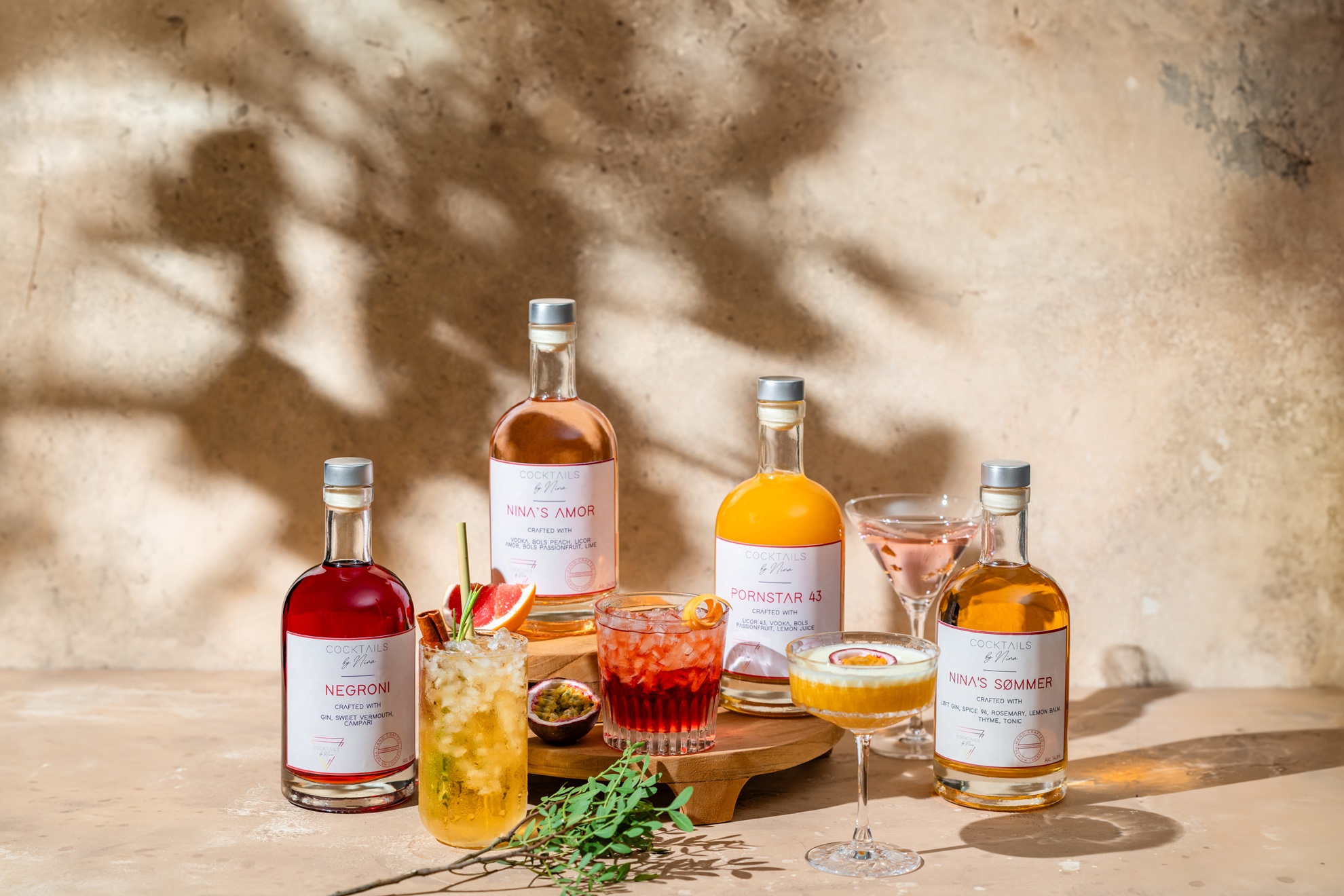
For those who prefer alcohol-free options, the selection of mocktails for purchase offers a wide range of professionally crafted non-alcoholic choices. From fresh and fruity to spicy and complex flavors, there's something suitable for every guest. Simply order online and receive everything at home, including any accessories and glassware for the complete experience.
Frequently Asked Questions about Cocktail Terms
What does ‘muddling’ mean in the cocktail world?
Muddling is the process of crushing ingredients like herbs or fruit to release more flavor. You use a muddler or a wooden spoon for this, and you always work directly in the glass or shaker.
Why should some cocktails be shaken and others stirred?
Shaking and stirring have different effects on flavor, texture, and clarity: shaking ensures mixing, cooling, and foam for cocktails with citrus or egg white, while stirring preserves clarity and texture, for example, in a Martini.
What is a dry shake and when do you use it?
A dry shake for egg white is a technique where you first shake without ice, ideal for cocktails with egg white for extra foam. Then you add ice for a second shake to cool.
Can I make mocktails using the same technique as cocktails?
Yes, cocktail techniques such as shaking and stirring are also fully applicable to mocktails. You shake, muddle, and garnish in exactly the same way; only the base ingredients change.