For most events, a compact menu of four to six cocktails, supplemented by at least one alcohol-free option, works better than a long list. Adjust the number of options to the group size: for fewer than 25 guests, 8 to 12 different drink options will suffice; for 25 to 50 guests, count on 12 to 15; and for more than 50 guests, you can aim for 15 to 20 options. Organize your ice supply, a batching plan, and a garnish station first. That determines whether the bar keeps running once it gets busy.
In short:
- For events under 25 guests, a menu with 8 to 12 different drinks is enough to satisfy everyone and keep preparation simple.
- A limited number of cocktails with three to four ingredients and seasonal products make the mixing process more efficient, especially during busy moments.
- For approximately 3 to 4 hours of festivities, count on three to four cocktails per person, with an additional drink per hour for longer events.
- A good ratio for evening events is approximately 60% alcoholic and 40% non-alcoholic drinks, while a 50/50 split is suitable for daytime events and mixed groups.
- Ready-to-serve cocktails and mocktails offer a practical solution for last-minute or smaller events without needing to mix them yourself.
Table of contents
- How many drinks to choose for your event cocktail menu
- Which cocktails to put on the menu
- Batching, ice, and mise-en-place for service
- Service models that fit your event
- Why quality over quantity matters at events
- Ready-to-serve solutions for your cocktail menu
- Sources
- Frequently asked questions
How many drinks to choose for your event cocktail menu
A larger selection sounds welcoming, but in practice, it works against you. Every additional cocktail on the menu means purchasing more ingredients, setting out more glassware, and longer waiting times at the bar. For events under 25 guests, a limited number of options is more than enough to offer everyone something without complicating the preparation. As the group size grows to medium-sized numbers, you can offer a few more drinks. Only with larger groups can a more extensive range be useful, simply because taste preferences become more varied.
Quantity is just as important as variety. A good rule of thumb: count on 3 to 4 cocktails per person for an event lasting approximately 3 to 4 hours. If the party lasts longer, add about one drink per extra hour. If you are serving an elaborate dinner alongside the cocktails, you can reduce that number by a quarter, as guests will switch between eating and drinking more often.
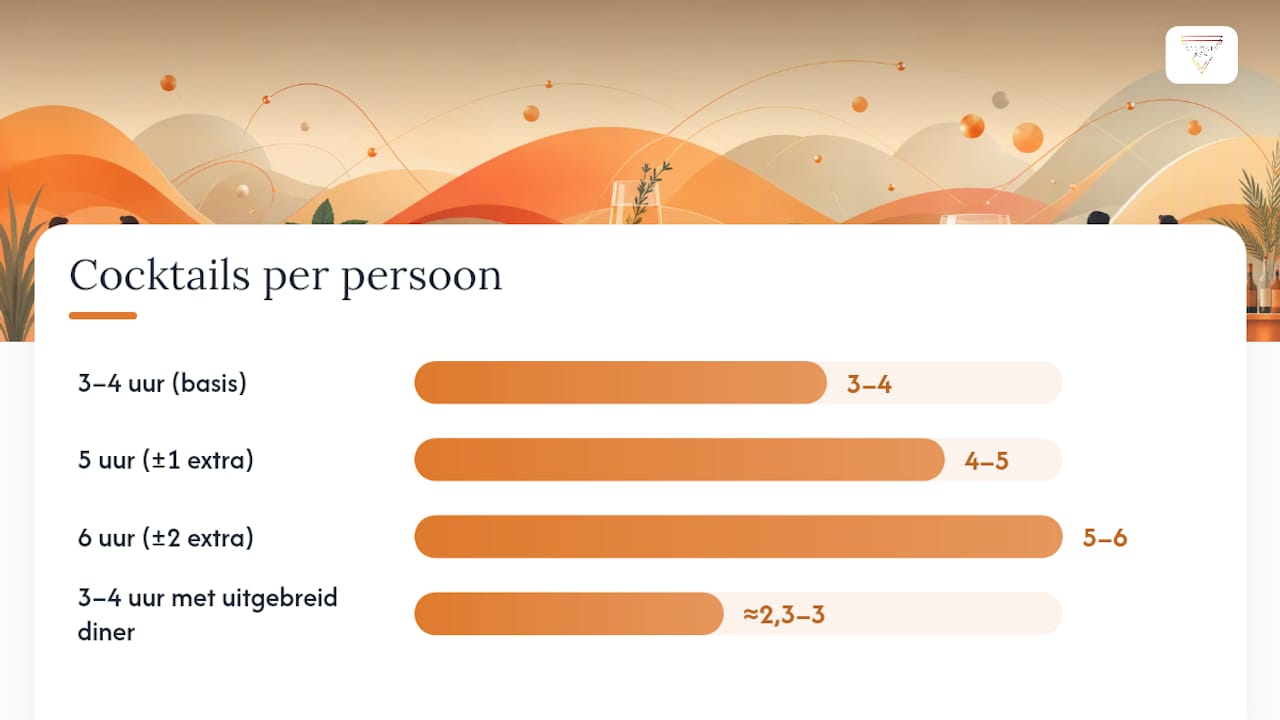
Pro-tip: Expect higher consumption at an after-work drinks event than at a lunch event. People who have just finished working tend to drink their first two glasses faster than those who have a short break in the middle of the day.
The balance between alcoholic and non-alcoholic drinks deserves as much attention as the number of options itself:
- For an evening event, a ratio of approximately 60% alcoholic to 40% non-alcoholic drinks works well.
- For a daytime corporate gathering or lunch event, you can shift that towards 50/50, as many guests will consciously choose to drink less alcohol.
- For a mixed crowd with many non-drinkers, it pays off to shift to a numerically larger cocktail menu.
Which cocktails to put on the menu
A strong menu doesn't start with a list of favorite recipes, but with a structure. An approach that works well: one signature cocktail that tells the story of the event's theme, two classics with a small twist, and one or two mocktails that receive as much attention as the alcoholic drinks. This arrangement keeps the menu organized and ensures that each drink has a clear function, rather than being chosen at random.
When choosing the specific recipes, a few practical criteria apply:
- Limit the number of ingredients. If you are working without a professional bartender, stick to three to four ingredients per cocktail. Any more becomes unmanageable during busy moments.
- Choose seasonal products. Fresh strawberries in the summer or candied orange in the winter give a cocktail immediate character without extra costs for exotic ingredients.
- Select for batchability. Cocktails that you can mix in large quantities in advance, such as a Negroni, Margarita, or Whiskey Sour, keep the service smooth when everyone is at the bar at the same time.
For the signature cocktail: this is the time to personalize. A unique name, a specific color that matches the decor, or a garnish that refers to the event's theme makes the difference between a standard list and a menu that guests will talk about later. You don't need to reinvent the classics; a small twist, such as a different bitter or an unusual garnish, is enough to make them fit this specific event. And for mocktails: treat them as full-fledged recipes with their own name and presentation, not as a last-resort solution for those who don't drink.
Batching, ice, and mise-en-place for service
Preparation largely determines whether your bar keeps running during the event or gets bogged down. Batching is the most important technique here: mix the base of cocktails like a Negroni, Margarita, or Whiskey Sour well in advance and store them chilled in large bottles or pitchers. Only add the ice and garnish when serving so that the taste and texture remain fresh. Do not batch cocktails with carbonated elements, such as tonic or prosecco: always add these separately.
For price calculation, a clear guideline applies: count on 1 to 1.5 kilograms of ice per 10 guests and buy 20% extra, as there is always loss due to melting and spilled ice during service. Additionally, check the cooling capacity at the location in advance. A full refrigerator at an outdoor location is one of the most underestimated problems at events.
A compact checklist for the mise-en-place:
- Sufficient measuring cups and written recipes, so that every cocktail looks the same, even if multiple people are serving.
- Fresh citrus, herbs, and garnishes prepared in portions, not loose in a bin that gets lost during the rush.
- A backup supply of at least 10% extra of every syrup or mixer, in case a cocktail turns out to be unexpectedly popular.
- A separate garnish station, distinct from the mixing station, so that the bar doesn't get stuck at the final finishing stage.
For those who prefer to go through this type of logistics in detail before the event begins, the complete practical guide on drink logistics offers a step-by-step breakdown of each of these points.
Service models that fit your event
The choice between a staffed bar, self-service, or a hybrid model determines not only the atmosphere but also how much preparation your menu requires. A staffed bar with a bartender works best for larger groups and more complex recipes, as consistency is guaranteed. Self-service is better suited to smaller, informal events: think of a pre-poured batch cocktail in a large pitcher with a handwritten note next to it. A hybrid setup, where guests tap the signature cocktail themselves but the bartender mixes the classics, combines the best of both.
Presentation determines how professional it feels, regardless of the number of options. A limited menu with a maximum of six cocktails is the clearest for smaller events, with the most popular or profitable options at the top of the menu. A few practical points that make a difference:
- Match the glassware to the type of cocktail; a Martini in a long drink glass immediately undermines the look.
- Use a clear visual hierarchy on the menu: signature cocktail first, classics after that, mocktails not as an afterthought at the bottom.
- Place garnishes visibly and clearly, so that guests can see for themselves what belongs in their glass.
- Adapt the setup to the location: at an outdoor party, you need more gas storage than in a room with professional refrigeration.
Why quality over quantity matters at events
A long menu with twenty cocktails looks impressive on paper, but anyone who has ever organized an event knows that the opposite is true: a limited menu that is perfectly executed every time makes more of an impression than an overcrowded list with varying quality. In their own logistics tips and etiquette advice, Cocktails by Nina emphasizes this exact point: consistency beats variety.
What organizers often underestimate is the role of mocktails. They are still treated too often as an obligatory chore, while a well-crafted non-alcoholic option is remembered just as well as the signature cocktail. Enlist professional help as soon as you notice that the logistics (ice, cooling, batching) require more time than you can free up yourself; that moment comes sooner than most organizers expect.
— Ruud
Ready-to-serve solutions for your cocktail menu
No time to batch yourself, organize ice, and prepare garnishes? Cocktailsbynina delivers top-quality, ready-to-serve cocktails with premium ingredients, so you don't have to mix anything yourself.
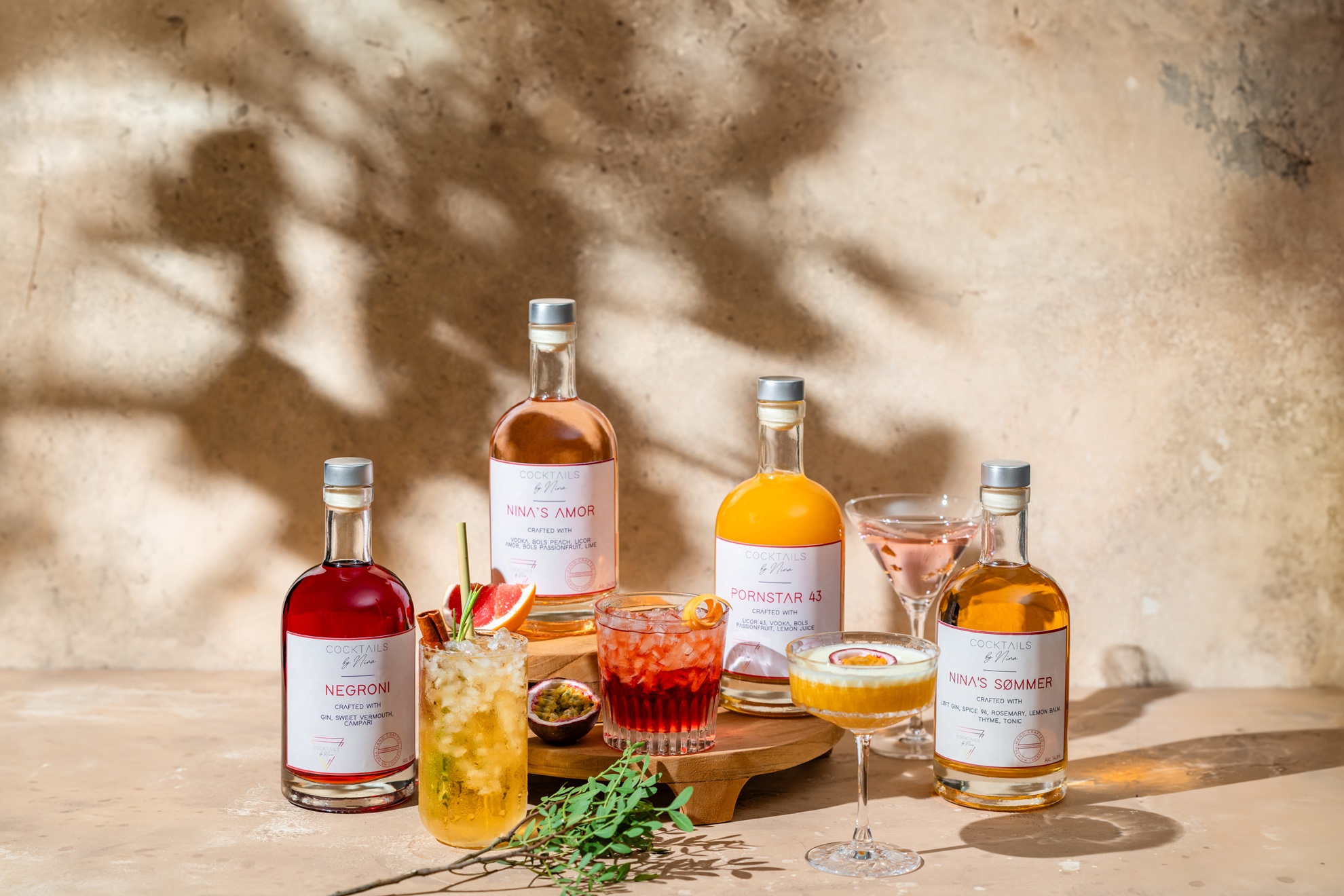
For small teams or last-minute planning, this is often the most practical route: you choose from the collection of cocktails or mocktails for the alcohol-free options, and for larger quantities, you can order everything at once via the cocktail boxes. Shipping is free on orders over a certain amount, and direct pickup options are available in Amsterdam. Would you rather have everything taken care of, from menu to service? Take a look at the possibilities for events and request a custom option for your next party or business meeting.
Sources
For the rules of thumb behind this article: BarsOnSight on cocktails per person, 24 ICE on ice and drink planning, and Shake and Serve on drink menus. For a broader perspective on event planning: the English-language guide from Wild Foodz on festive menu planning.
Frequently asked questions
How many cocktails do I need for 50 guests?
For 25 to 50 guests, a menu with 12 to 15 different options works best, supplemented with a few mocktails. Count on 3 to 4 cocktails per person for an event lasting 3 to 4 hours, and add about one drink per extra hour.
Which cocktails are best to batch in advance?
Cocktails containing only spirits, bitters, and syrups are easiest to batch, such as a Negroni, Margarita, or Whiskey Sour. Add ice and garnish only when serving, and always keep cocktails with carbonation like tonic or prosecco separate.
How much ice do I need for a cocktail party?
Count on 1 to 1.5 kilograms of ice per 10 guests and buy an additional 20% to account for melting loss. Always check in advance if the cooling capacity at the location is sufficient.
How many alcohol-free options should be on a cocktail menu?
For a business lunch or a mixed group with many non-drinkers, that share can be even higher.
Can I order a ready-to-serve cocktail menu for my event?
Yes, Cocktailsbynina offers ready-to-serve cocktails, mocktails, and cocktail boxes that are ready for immediate service, without you having to mix them yourself. Current prices and assortments are on the website, and for larger orders, a custom option is available via the event service.