Count on 3 to 4 cocktails per person for a three-to-four-hour party. That's the rule of thumb for stress-free purchasing, which you adjust based on duration, event type, and guest profile.
For a two-hour business reception, 2 to 3 cocktails per person are usually sufficient. If the party lasts longer, add one extra cocktail per extra hour on top of the base. Always build in a small buffer, as guests rarely drink exactly evenly distributed, and no one wants to run out of ice or lime.
- Standard cocktail party (3-4 hours): 3-4 cocktails per person
- Business reception (2 hours): 2-3 cocktails per person
- Longer evening: +1 cocktail per extra hour
- Buffer: 10-15% extra purchases
- Non-alcoholic proportion: at least 30-40% of the total
Rule of thumb in figures: for a 3 to 4-hour cocktail party, 3 to 4 cocktails per person is the standard, while business afternoon receptions are structurally lower due to less alcohol consumption during working hours.
Key insights
The number of cocktails you need per person is determined by duration, event type, and the ratio of alcoholic to non-alcoholic, not by a fixed number.
| Point | Details |
|---|---|
| Basic rule of thumb | Count on 3 to 4 cocktails per person for a 3 to 4-hour party. |
| Duration adjustment | Add one cocktail per person for each extra hour beyond the standard duration. |
| Food reduces consumption | A full dinner reduces cocktail consumption by 20 to 25%. |
| Non-alcoholic proportion | Provide at least 30 to 40% non-alcoholic options, more for business events. |
| Ready-made solution | Cocktail boxes and mocktails from Cocktails by Nina cover your calculated number without mixing hassle. |
Table of contents
- How many cocktails per person for different event durations?
- Which factors change your cocktail consumption?
- How many bottles and shots do you need per cocktail?
- Checklist for purchasing and planning your cocktail party
- When is a ready-made cocktail box smarter than mixing yourself?
- The rule of thumb is a starting point, not the truth
- Order your cocktails in advance and save on planning stress
- Sources
How many cocktails per person for different event durations?
The number of cocktails per person depends more on the duration of your party than on the number of guests. A two-hour reception requires a completely different purchasing plan than a five-hour evening party.
| Event duration | Cocktails per person | Event type |
|---|---|---|
| 2 hours | 2-3 | Business reception, networking event |
| 3 hours | 3-4 | Birthday, reception |
| 4 hours | 4-5 | Evening party, wedding party |
| 5+ hours | 5-6 | Party with dinner and dancing |
Two calculation examples make this concrete:
- 50 guests, 3-hour party: 50 × 3.5 cocktails = 175 cocktails, plus 10% buffer = approximately 193 cocktails total.
- 100 guests, 4-hour party: 100 × 4.5 cocktails = 450 cocktails, plus 10% buffer = approximately 495 cocktails total.
Business events systematically differ from private parties. A reception with varying ranges per hour shows that a quiet reception comes out at 1.5 to 2 drinks per hour, compared to 3 per hour at a distinctly festive occasion.
Which factors change your cocktail consumption?
Four factors influence your number of cocktails per person, of which the duration of the event is the largest. For every hour longer than the standard three hours, you can count on approximately one extra cocktail per person. This follows the same logic as the rule of thumb where you count on three drinks in the first hour and then two extra per hour, which quickly brings a two-hour reception to five drinks per person.
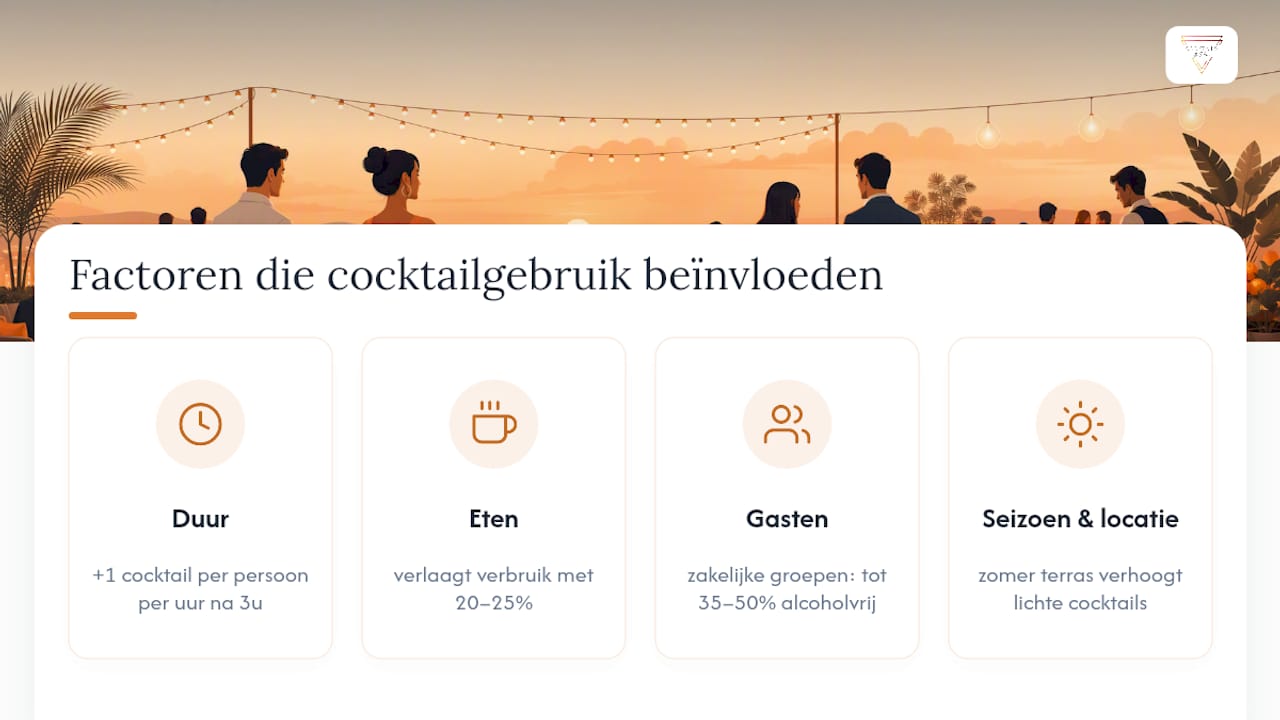
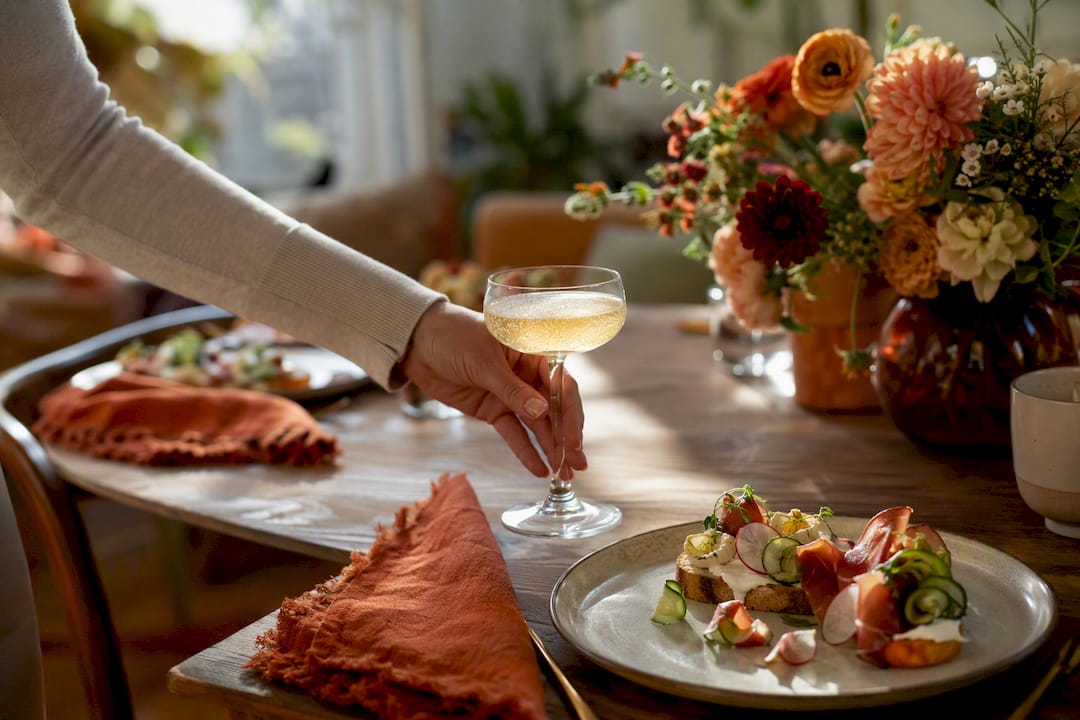
Eating at the table slows down drinking. If you serve a full dinner or an extensive walking dinner, cocktail consumption drops by 20 to 25% compared to a party without a meal. Guests drink slower when they eat in between, and alcohol is also absorbed more slowly.
The composition of your guests also matters significantly. Business groups drink systematically less and require more non-alcoholic options, sometimes up to 35 to 50% of the total offering.
Season and location do the rest. A summer terrace with temperatures above 25 degrees increases the consumption of light, refreshing cocktails, while an indoor winter party leads to more distribution between warm drinks and cocktails.
Pro-tip: When sending out invitations, ask guests if they prefer non-alcoholic drinks. This information will save you a lot of guesswork when purchasing.
How many bottles and shots do you need per cocktail?
Once you know the number of cocktails per person, you need to convert that into bottles, shots, and mixers. An average cocktail contains 120 to 180 milliliters of liquid, of which usually 40 milliliters is pure spirits.
With 40 milliliters per cocktail as a starting point, a simple division applies: a 700-milliliter bottle yields approximately 17 to 18 cocktails. For shots, the same logic works slightly differently: a 70-centiliter bottle yields approximately 23 shots of 30 milliliters, or 28 shots with a smaller shot size of 25 milliliters.
A calculation example for a party of 50 guests with four cocktails per person:
- Total number of cocktails: 50 × 4 = 200 cocktails.
- Required spirit: 200 × 40 ml = 8,000 ml, divided by 700 ml per bottle = just over 11 bottles of gin, rum, or vodka.
- Mixers and soft drinks: count on at least 1.5 times the volume of the spirit, so approximately 12 liters of tonic, cola, or lime juice.
- Ice: at least 0.5 to 1 kilo per person, so 25 to 50 kilos for this group.
These proportions shift with the type of cocktail. A strong, spirit-forward cocktail like a Negroni uses less mixer than a long drink like a Mojito, which can significantly reduce your total mixer volume.
Checklist for purchasing and planning your cocktail party
Before you order, it's best to go through these points. They prevent the two classic mistakes: too little ice and too much variety.
- Count on a 10 to 15% buffer above your calculated number, or structurally plan one extra drink per person if you are uncertain about attendance.
- Limit the number of cocktail types: 8 to 12 options are sufficient for up to 25 guests, 12 to 15 for 25 to 50 guests, and 15 to 20 for larger groups.
- Order plenty of ice: at least 0.5 to 1 kilo per person, depending on the duration and whether you are serving outdoors.
- Choose between a bartender who shakes live, batching in large pitchers, or ready-made bottles; batching saves time but results in a slightly less theatrical presentation.
- Distribute glassware logically: separate glasses for non-alcoholic drinks prevent confusion and accidental double pouring.
- Place allergens and ingredients visibly at the buffet, especially for nut, lactose, or citrus allergies.
- Use sustainable straws and stirrers instead of disposable plastic.
Pro-tip: For the last round, consciously serve more non-alcoholic options. This keeps the atmosphere high without guests regretting it the next morning, and it saves you significantly on the purchase of spirits.
When is a ready-made cocktail box smarter than mixing yourself?
As soon as you exceed 20 guests, mixing yourself becomes a logistical challenge: every cocktail requires precision, and mistakes in proportion are immediately noticeable. Ready-made cocktails and batch solutions solve this with three concrete advantages.
- Time savings: no shaker, no jigger, no waiting time at the bar.
- Consistent taste: every cocktail tastes the same, even for the last guest.
- Simple inventory management: you count bottles or boxes instead of individual ingredients.
A simple ordering approach: cover your calculated number (e.g., 200 cocktails for 50 guests) with a combination of cocktail boxes for the core of your offering and loose mixers for variety. Those who want to read more about batching for large groups can find practical tips in this article about cocktails for large groups.
The rule of thumb is a starting point, not the truth
Most planners make one mistake: they treat "3 to 4 cocktails per person" as a law instead of a starting point. That number is useful for starting purchases, but it says nothing about your specific guest list.
What conventional advice often underestimates is the weight of the guest profile. A group of thirty-somethings just starting an evening out will approach it differently than colleagues who still have to drive at 6:00 PM. For the first group, feel free to count on the higher end of the range, and for the second, significantly lower, with a larger proportion of non-alcoholic options.
What I am most critical about is the tendency to purchase too much variety "just in case." More types of cocktails mean more bottles, more chance of waste, and a more complicated bar. Consciously limit your offerings, base your buffer on quantity rather than choice stress, and your party will run more smoothly than if you try to stock twenty different recipes.
Priority number one: first determine the duration and type of guests, then the number of types of cocktails.
— Ruud
Order your cocktails in advance and save on planning stress
Cocktails by Nina delivers ready-made cocktails and mocktails that you can perfectly match to the number you have calculated, without the hassle of shakers, jiggers, or leftover fresh ingredients that you would otherwise throw away.
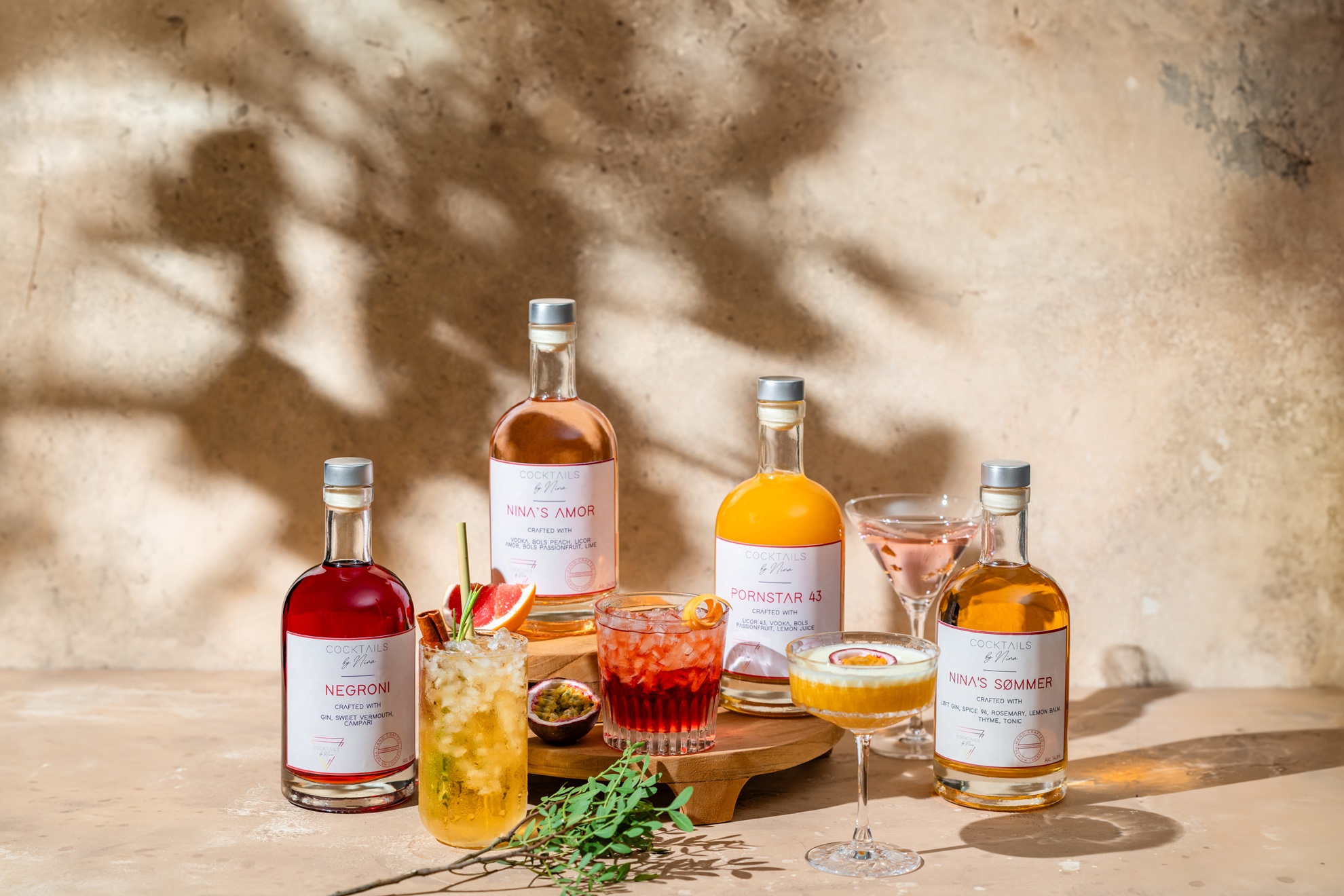
For a party of 50 guests, for example, combine a number of cocktail boxes with 6 pieces with an addition from the collection of ready-made mocktails to effortlessly achieve your non-alcoholic share of 30 to 40%. Are you unsure about the exact quantities for a larger business event? Then request a quote for custom catering, or view the shot box with 5 pieces of 50 ml as an addition to your bar. Order online today and have your numbers sorted before the first guest arrives.
Sources
- How much drink needed for an event? — Ken je kom
- How many cocktails per person are normal for a cocktail party? — BarsOnSight
- How many drinks per person at a reception — Noahs Events
- How to create a drink menu for your party? — Cocktailtravelers