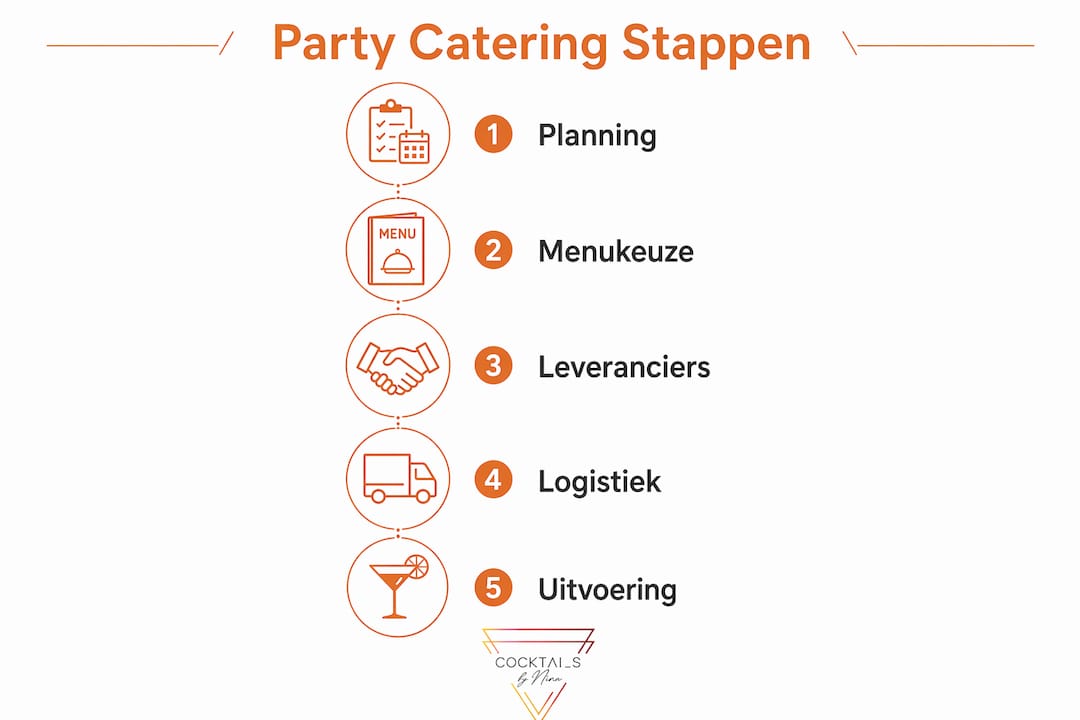
The party catering process is the systematic approach by which event organizers manage the food, beverages, and service for their event from start to finish. Following this process correctly prevents chaos on the day itself and ensures that guests are well taken care of. The approach consists of four recognizable phases: planning, menu selection, vendor selection, and execution. Professional caterers use standard documents such as the Banquet Event Order (BEO) and fixed checklists. Those who organize catered parties would do well to understand this structure in advance.
How do you start planning party catering?
The foundation of any successful catering process lies in early and concrete planning. Starting too late leads to full schedules for suppliers, higher prices, and insufficient time to gather dietary requirements. For large events, a rule of thumb is to start 12 weeks in advance with setting the date, location, and budget.
The first step is to determine three core variables: the number of guests, the location, and the available budget. These three together determine which catering format is feasible. A buffet for 80 people requires a different approach than a three-course dinner for 20 guests.

Next, you create a planning timeline. Major decisions, such as choosing a caterer and finalizing the menu, should be made in the first four weeks. The final guest list and dietary requirements should be confirmed 5 to 7 days before the party. This gives the caterer sufficient time to purchase ingredients and prepare the kitchen.
Early communication with caterers is not a luxury. Contacting them early provides more room for negotiation on price and menu. Moreover, it gives the supplier time to contribute ideas for the party's setup.
Planning steps at a glance:
- Set date, location, and budget (at least 12 weeks in advance)
- Determine the type of service: buffet, table service, or walking dinner
- Request quotes from at least three caterers
- Prepare a vendor brief with all logistical details
- Confirm the final guest list 5 to 7 days before the party
Pro-tip: Use a party organization checklist as a guide for your planning. A standardized checklist significantly reduces miscommunication and service errors.
How do you choose the right menu and account for dietary requirements?
The menu is the heart of any catering concept. A good menu choice considers the atmosphere of the party, the composition of the group, and the practical possibilities of the venue. A standing buffet suits an informal party; a served dinner suits a formal occasion.
Menu formats and service types
The most common forms are buffet, walking dinner, and table service. At a buffet, guests choose what they want, which is flexible but can also lead to more food waste. A walking dinner with small bites works well for networking events. Table service provides the most control over portions and timing.
Gathering and processing dietary requirements
Always distinguish between preferences and medical allergies. A guest who prefers not to eat meat has different needs than someone with a severe nut allergy. This distinction determines which safety protocols the caterer must follow to prevent cross-contamination.
Gather dietary requirements via the invitation or a separate form. Ask two questions: “Do you have an allergy or intolerance?” and “Do you have a preference or wish?” These two questions provide the caterer with the necessary information to cook safely and inclusively.
Considerations for inclusive catering:
- Always offer at least one vegetarian and one vegan option
- Clearly mark allergens for each dish on the buffet
- Ask the caterer about their cross-contamination protocol
- Note all dietary requirements in the BEO so kitchen and service have the same information
- Recheck the menu if it changes just before the party
Pro-tip: When gathering dietary requirements, also ask about the severity of the allergy. Safely handling dietary requirements involves recording the severity to avoid cross-contamination and reputational damage.
The menu choice also directly affects the experience of the party. Guests who are well-fed and feel understood in their wishes are relaxed and enjoy themselves more. This is the silent contribution of a well-thought-out menu.
How do you select and communicate with catering suppliers?
Choosing a caterer is one of the most critical decisions in the entire process. Price is just one factor. Experience with your type of party, flexibility with changes, and quality of communication are at least as important.
Comparing based on the right criteria
Ask each caterer for references from similar events. A caterer with experience in corporate happy hours may not be the best choice for a wedding of 150 people. Also, ask about their approach to last-minute changes and how they handle dietary requirements.
Party catering budgets vary widely. Catering costs range from €25 to €150 per person, depending on the type of service and the scale of the event. Festive events typically cost significantly more than a standard business lunch. This difference lies in staff, decoration, and ingredient quality.
The Banquet Event Order as an operational blueprint
The Banquet Event Order, or BEO for short, is the central document in any professional catering process. A BEO contains all logistical and service details of the event: the menu, timeline, staff instructions, room setup, and special instructions. The document is signed by the client and serves as a binding agreement.
The big advantage of a BEO is that it functions as a living document. Changes are processed immediately, so the kitchen, service, and sales always have the same version. Finalize the BEO 7 to 10 days before the party to ensure sufficient preparation time.
Steps for good supplier selection
- Create a longlist of at least three caterers based on recommendations and online reviews
- Send each caterer a vendor brief with the date, location, number of guests, and desired service
- Compare quotes on price per person, including staff and materials
- Schedule a tasting or trial menu to assess quality and communication style
- Document all agreements in a BEO and have both parties sign
| Criterium | Wat je controleert |
|---|---|
| Experience | Similar events in portfolio |
| Price | Cost per person, including staff |
| Flexibility | Policy for last-minute changes |
| Communication | Response time and clarity of quotes |
| Food safety | Protocol for allergens and cross-contamination |
Vendor briefs prevent days of communication discrepancies and immediately provide the caterer with all the information needed to create a competitive quote.
What are the logistical steps on the day of the party?
Execution on the day itself stands or falls with preparation and coordination. Even the best menu fails if the logistics are wrong. Therefore, always designate one point of contact on-site, someone who can guide the caterer and make decisions.
Successful caterers anticipate guest flows and transitions before they cause problems. This means knowing when guests arrive, when the buffet opens, and when plates are cleared. This timing determines whether the party runs smoothly or feels chaotic.
Logistical considerations on the day itself:
- Upon arrival, check if the setup matches the BEO
- Review inventory: are all ingredients and materials present?
- Discuss the timeline again with the caterer and staff
- Ensure the point of contact is reachable by phone throughout the party
- Maintain a small buffer for extra portions for unexpected guests
The role of an on-site bartender is an underestimated part of logistics. A good bartender not only manages drinks but also monitors the pace of the evening and signals when supplies are running low.
Last-minute changes are part of every party. A guest who doesn't show up, a dietary requirement reported only on the day itself: it happens to every organizer. The key is a flexible caterer who is accustomed to such situations and can react quickly.
How to avoid common mistakes in party catering?
Most mistakes in party catering don't happen on the day itself, but in the weeks leading up to it. Unclear communication, an incomplete guest list, or an unupdated BEO: these are the real culprits.
“The key to a flawless event is a standardized checklist, which greatly reduces miscommunication and service errors.”
Common mistakes and how to prevent them:
- No final guest list: confirm numbers at least 5 to 7 days in advance
- Dietary requirements not recorded in the BEO: always add them as a separate section
- No backup plan for no-shows: agree with the caterer what happens to leftovers
- Poor communication in case of delays: proactively inform guests and give the caterer room to adjust
- BEO not updated after changes: treat the BEO as a living document and update it immediately with every change
RSVP management is an underestimated part of the party catering process. Without a hard deadline for registrations, there is no reliable basis for purchasing and staff planning. Set an RSVP deadline that is at least 10 days before the party.
Contingency planning specifically means: what do you do if 15% of the guests don't show up? Agree in advance whether the caterer adjusts the quantity or if the surplus is packed. This prevents discussions afterward and food waste.
Pro-tip: Treat the BEO as a live document for catering. Every change, no matter how small, should be immediately entered into the document. This ensures everyone always has the same information.
My honest take on the party catering process
Why structure makes a difference in party catering
After years of organizing parties and experiencing catering processes firsthand, one thing has become clear to me: most problems arise not from bad caterers, but from unclear expectations. Organizers think a verbal agreement is sufficient. It is not.
The BEO is not just a form. It is the only document that ensures the kitchen, the service, and you as the organizer all have the same party in mind. Taking that document seriously prevents 80% of problems.
What also strikes me: organizers focus too much on the menu and too little on logistics. The most beautiful menu in the world is useless if the setup is wrong, staff arrive late, or drinks run out before half the guests have had a glass. The magic of catering lies in the invisible coordination that makes an event run smoothly.
My advice: where possible, work with a total concept where catering, beverages, and logistics are coordinated by one party. This limits the number of suppliers, reduces stress, and provides a single point of contact. If that's not possible, at least ensure a clear BEO and a vendor brief that leaves nothing to the imagination.
A well-organized party feels effortless for guests. That effortless feeling is the result of hours of unseen preparation. That's exactly what the party catering process is all about.
— Ruud
Professional drinks that complete your party catering
A party without good drinks is missing something essential. Cocktailsbynina offers ready-to-drink cocktails and mocktails that fit directly into any catering concept, without you having to mix or prepare them yourself.

Cocktailsbynina's assortment includes ready-to-drink mocktails and non-alcoholic cocktails suitable for any type of party. From an intimate birthday celebration to a larger corporate event: the drinks are made with premium ingredients and have the quality of a professional bar. For organizers who also want to take care of the drink experience, Cocktailsbynina offers a simple and high-quality solution that seamlessly integrates into the catering process.
Frequently Asked Questions
What is a Banquet Event Order (BEO)?
A BEO is the central document in the catering process that records all logistical and service details of an event, including the menu, timeline, and staff instructions. It is signed by both parties and serves as a binding agreement.
How early should you plan party catering?
For large events, start at least 12 weeks in advance by setting the date, location, and budget. The final guest list and dietary requirements should be confirmed 5 to 7 days before the party.
How do you collect dietary requirements for a party?
Ask about both allergies and preferences via the invitation, always distinguishing between the two. Record all dietary requirements in the BEO so that the kitchen and service have the same information.
What does party catering cost on average per person?
Catering costs vary widely depending on the type of service and the scale of the event. Festive events generally cost significantly more than a standard business lunch due to higher demands on staff, presentation, and ingredients.
How do you prevent mistakes on the day of the party?
Designate one point of contact on-site, check the setup against the BEO upon arrival, and discuss the timeline again with the catering team. An updated BEO and a fixed checklist prevent most problems.
Key Insights
The party catering process requires early planning, a clear BEO, and direct communication with suppliers to prevent mistakes and last-minute chaos.
| Point | Details |
|---|---|
| Start planning early | Begin at least 12 weeks in advance by setting the date, location, and budget. |
| Use a BEO | Record all agreements in a Banquet Event Order and update this document with every change. |
| Distinguish between allergies and preferences | When gathering dietary requirements, always ask about the severity to ensure food safety. |
| Designate a point of contact | One contact person on-site prevents confusion and speeds up decisions on the day itself. |
| Work with a total concept | Coordinate catering, drinks, and logistics from a single party to reduce stress. |